

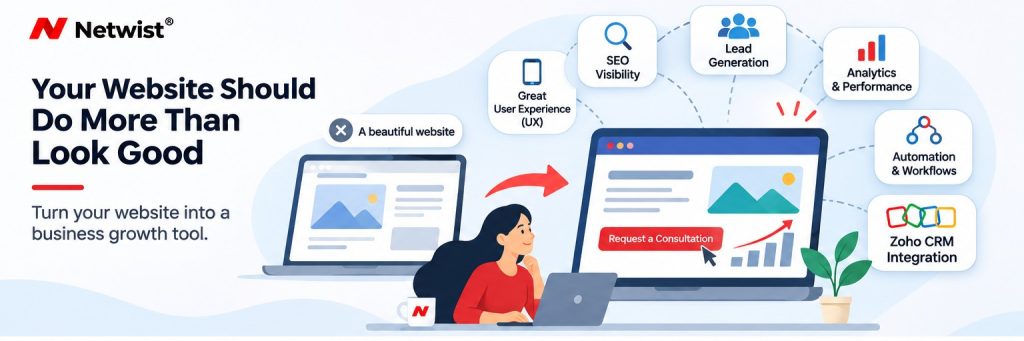
A beautiful website can make a great first impression. But a successful business website should do much more: attract the right visitors, generate qualified leads, build trust, and turn online interest into measurable business opportunities.
Why Choosing an Experienced Web Development Partner Makes All the Difference
Building a professional business website is about much more than attractive design or writing code. It is a strategic investment that requires a deep understanding of your business, technical expertise, thoughtful design, SEO, security, and an excellent user experience. Artificial Intelligence (AI) tools can significantly accelerate website development, but the real difference between an experienced professional and someone who simply enters prompts into an AI tool lies in expertise, critical thinking, and accountability for the final result. An experienced web development partner goes beyond what an AI tool can generate. They analyze your business needs, anticipate technical challenges, evaluate the quality of proposed solutions, and build a website that is secure, scalable, and designed to deliver measurable results. Because the goal is not simply to have a website, but to create a reliable digital asset that supports your business growth.
Is Your Website Actually Helping Your Business Grow?
Your website is often the first interaction a potential customer has with your business.
Before calling, requesting a quotation, booking an appointment, or purchasing a service, people usually want to learn more about your company.
They visit your website to understand what you offer, evaluate your credibility, and decide whether you are the right choice.
A modern design can certainly help create a positive first impression.
But what happens after that?
Does your website clearly explain your services?
Can visitors quickly find what they need?
Is it easy to contact your business?
Does your website appear in relevant Google searches?
Are inquiries properly captured and followed up?
If your website looks impressive but fails to support these goals, it may be functioning more like a digital brochure than a business growth tool.
A successful website should combine attractive design with strategy, usability, search visibility, performance, and conversion optimization.
Let’s explore what that means in practice.
1. Your Website Should Attract the Right Visitors
A website cannot generate meaningful business opportunities if potential customers cannot find it.
This is where Search Engine Optimization (SEO) becomes essential.
SEO helps search engines understand your website and makes your content more discoverable for relevant searches.
However, effective SEO is not simply about adding keywords to pages.
It requires a combination of technical optimization, useful content, clear website structure, and a strong understanding of search intent.
What should an SEO-friendly website include?
- Clear page titles and meta descriptions.
- Well-structured headings and relevant content.
- Descriptive URLs.
- Mobile-friendly layouts.
- Fast, accessible pages.
- Logical internal linking.
- Appropriate image optimization.
- Structured data where relevant.
- Proper indexing and crawlability.
Practical example
Imagine a company offering professional website development in Athens.
Its website may look beautiful, but if its service pages contain little useful information or use vague headings, search engines may struggle to understand their relevance.
A more effective approach would include dedicated service pages explaining website development, eCommerce solutions, website maintenance, and business integrations.
Each page should address real customer questions and provide a clear next step.
The goal is not simply to attract more traffic.
It is to attract visitors who are genuinely interested in your products or services.
2. Your Website Should Turn Visitors into Leads
Getting visitors to your website is only the beginning.
The next challenge is encouraging them to take meaningful action.
A conversion occurs when a visitor completes an action that supports a business goal.
Depending on the website, this could mean:
- Submitting a contact form.
- Requesting a quotation.
- Booking a consultation.
- Calling your business.
- Making a purchase.
- Registering for a service.
- Downloading a useful resource.
This is where Conversion Rate Optimization (CRO) becomes important.
CRO focuses on improving the website experience so that more relevant visitors complete valuable actions.
The importance of clear calls to action
Every important page should help visitors understand what to do next.
For example, instead of ending a service page without direction, a business could include a clear CTA such as:
Request a Free Consultation
Get a Personalized Quote
Talk to Our Team
Discover the Right Solution for Your Business
The wording should match the visitor’s intent and the service being offered.
A visitor exploring a complex business solution may prefer to request a consultation rather than make an immediate purchase.
Practical example: A website with 1,000 monthly visitors
Consider a hypothetical business website receiving 1,000 visitors per month.
If 1% of those visitors submit an inquiry, the website generates 10 leads.
If improvements in messaging, usability, and calls to action increase the conversion rate to 2%, the website generates 20 leads from the same traffic.
| Metric | Before Optimization | After Optimization |
|---|---|---|
| Monthly visitors | 1,000 | 1,000 |
| Conversion rate | 1% | 2% |
| Monthly leads | 10 | 20 |
| Annual leads | 120 | 240 |
That represents 120 additional leads per year without increasing website traffic.
This is an illustrative calculation, not a prediction or guaranteed result. Actual conversion rates depend on traffic quality, industry, offer, and website performance.
The example demonstrates why improving an existing website can sometimes be as important as attracting more visitors.
3. Your Website Should Build Trust Before the First Conversation
People rarely contact a business simply because its website looks modern.
They also need confidence that the company understands their needs and can deliver the promised service.
A trustworthy website should communicate credibility through clear and useful information.
Elements that help build confidence
Professional design
A consistent visual identity, readable typography, and organized layout help create a professional impression.
Clear service descriptions
Visitors should quickly understand what your business offers and who those services are designed for.
Real testimonials and case studies
Authentic customer experiences and documented project examples can help demonstrate relevant expertise.
Transparent company information
Contact details, company information, and clear explanations of the services provided make it easier for visitors to evaluate the business.
Security and privacy
HTTPS, appropriate data protection practices, and transparent privacy information are essential parts of a responsible website.
Helpful content
Articles, FAQs, guides, and educational resources demonstrate knowledge while helping customers make informed decisions.
Trust is not created by design alone.
It is built through the complete experience a visitor has with your business.
4. Your Website Should Be Fast, Mobile-Friendly, and Easy to Use
A visually impressive website can still deliver a frustrating experience.
Large images, excessive animations, complicated navigation, and poorly optimized code can slow down pages and make them difficult to use.
This is particularly important for mobile visitors.
A responsive website should adapt naturally to different screen sizes and allow users to complete important actions without unnecessary effort.
What should businesses prioritize?
- Responsive layouts for smartphones, tablets, and desktops.
- Optimized images and media.
- Efficient loading of scripts and resources.
- Simple navigation.
- Readable typography.
- Accessible forms and buttons.
- Reliable hosting and caching.
- Consistent performance across key pages.
5. Your Website Should Connect with Your Business Tools
One of the biggest missed opportunities in website development is treating the website as an isolated platform.
Imagine that a potential customer submits an inquiry through your contact form.
What happens next?
Does the message simply arrive in a shared email inbox?
Does someone manually copy the information into a spreadsheet?
Is the inquiry assigned to a salesperson?
Is there a process to ensure that the customer receives a timely response?
A website can become much more valuable when it connects with the systems your business already uses.
Website integration with Zoho CRM
For businesses using Zoho CRM, website forms can be connected to customer management workflows.
With the appropriate integration and configuration, a new inquiry can trigger a structured process:
Website Form → Zoho CRM → Lead Assignment → Sales Notification → Follow-Up Task
Instead of relying entirely on manual processes, the business can organize inquiries in one place.
Sales teams can monitor the progress of opportunities and maintain a clearer record of customer interactions.
Other useful website integrations
Depending on business needs, websites can also connect with:
- Zoho Campaigns
- Zoho Desk
- Zoho Bookings
- Zoho Flow
- Zoho Analytics
- Zoho Forms
The objective is not to integrate every available application.
It is to connect the website with the tools that create real operational value.
6. Your Website Should Automate Repetitive Processes
Many businesses still rely on manual activities that could be simplified through suitable website integrations.
For example, employees may repeatedly:
- Forward incoming inquiries to the correct department.
- Copy contact information into a CRM.
- Send appointment confirmations.
- Create internal tasks.
- Notify colleagues about new customer requests.
- Transfer information between business applications.
With appropriate automation, some of these activities can be completed more consistently and with less manual intervention.
Practical example: Automating consultation requests
A consulting company receives requests through its website.
A visitor completes a consultation form.
The submitted information is validated and transferred to the CRM.
A workflow assigns the inquiry to the appropriate team member.
An acknowledgment email is sent to the visitor.
A follow-up task is created for the salesperson.
Management can monitor the status of inquiries.
This process requires proper integration, workflow configuration, and attention to privacy and security.
When implemented correctly, it can reduce administrative work and make it easier to track customer requests.
7. Your Website Should Support the Entire Customer Journey
A business website should not focus exclusively on attracting first-time visitors.
It can also support customers throughout their relationship with your company.
A typical customer journey may include several stages:
Awareness
The customer discovers your business through search engines, recommendations, advertising, or social media.
Useful blog articles and educational content can help answer initial questions.
Consideration
The visitor compares providers, evaluates services, and explores available solutions.
Detailed service pages, FAQs, and relevant case studies can help.
Decision
The customer is ready to contact your business, request a quotation, or purchase a service.
Clear CTAs and simple forms reduce unnecessary friction.
Retention
Existing customers may return for additional services, upgrades, or ongoing support.
A well-structured website can continue supporting the relationship long after the first conversion.
Your website should contribute to the complete customer experience, not just the initial sale.
8. Your Website Should Provide Useful Business Data
A website should help businesses understand what is working and where improvements are needed.
Without reliable measurement, decisions are often based on assumptions.
Website analytics can provide insight into how visitors discover and interact with your content.
Important metrics to monitor
| Metric | What It Helps You Understand |
|---|---|
| Organic search traffic | Visibility through search engines |
| Landing page performance | Which pages attract visitors |
| Conversion rate | How effectively visitors complete key actions |
| Qualified leads | Whether inquiries match your target customers |
| Form completion rate | How easily visitors submit requests |
| Engagement | How visitors interact with content |
| Core Web Vitals | Technical user experience |
| Lead-to-customer conversion | How inquiries contribute to actual sales |
9. Your Website Should Grow with Your Business
A website that meets your needs today may not be sufficient two years from now.
As your business expands, you may need:
- Additional service pages.
- Multiple languages.
- New contact and lead generation forms.
- eCommerce capabilities.
- Customer portals.
- Appointment scheduling.
- CRM integrations.
- Marketing automation.
- Advanced reporting.
- Integration with internal business systems.
This is why website architecture matters.
A scalable website should be designed with future requirements in mind.
For businesses using WordPress, for example, thoughtful theme selection, plugin management, hosting infrastructure, security practices, and integration architecture can make ongoing development more manageable.
A website should not require a complete redesign every time your business introduces a new service or process.
10. Why Strategy Matters More Than Visual Design Alone
Design is important.
But successful website development starts before the first layout is created.
It begins with understanding the business.
Who are your ideal customers?
What problems are they trying to solve?
What makes your services different?
Which actions should visitors take?
What happens after a lead is generated?
How will website performance be measured?
These questions influence the website’s structure, content, navigation, conversion paths, and technical integrations.
A strategic website development process should consider:
Business goals: Define what the website should achieve.
Audience needs: Understand visitor expectations and search intent.
Information architecture: Organize pages around clear user journeys.
Content strategy: Create useful, relevant, and search-friendly content.
User experience: Make important tasks simple and intuitive.
Technical performance: Prioritize speed, accessibility, security, and reliability.
Conversion optimization: Make it easy for visitors to take the next step.
Business integration: Connect the website with relevant operational systems.
Measurement: Monitor results and identify opportunities for improvement.
A website designed around these principles has a stronger foundation for delivering long-term business value.
How Netwist Can Help Turn Your Website into a Business Growth Tool
At Netwist, we believe a business website should combine professional design with meaningful functionality.
A successful website should represent your brand, communicate your value, and support the processes that help your business operate effectively.
Rather than focusing exclusively on appearance, Netwist can help businesses evaluate and develop website solutions that bring together design, usability, technical performance, and business integrations.
Website Design and Development
Creating modern, responsive websites that reflect your business identity and make it easier for customers to understand your services.
WordPress Website Solutions
Developing and improving WordPress-based websites with attention to usability, content management, performance, and maintainability.
SEO-Friendly Website Structure
Planning website architecture, page structure, and content organization to support search engine discoverability and relevant visitor journeys.
Website Performance Optimization
Identifying opportunities to improve loading performance, mobile usability, and the overall user experience.
Conversion-Focused Design
Improving navigation, forms, service pages, and calls to action so that visitors can take meaningful next steps.
Zoho CRM and Business Application Integration
Exploring how website inquiries and customer interactions can be connected with Zoho CRM and other compatible business applications.
Workflow Automation
Identifying opportunities to automate selected activities, reduce manual data entry, and improve coordination between website and business processes.
The right solution depends on the goals, systems, and operational requirements of each organization.
Our focus is to help businesses move beyond simply having an attractive website toward creating a digital platform that supports real business needs.
Frequently Asked Questions
Why is website design alone not enough?
Visual design influences first impressions, but a successful business website also needs useful content, intuitive navigation, strong technical performance, clear conversion paths, and appropriate business functionality.
How can a website generate more leads?
A website can improve lead generation through relevant search visibility, persuasive service content, clear calls to action, accessible contact forms, and continuous conversion optimization.
What is conversion rate optimization?
Conversion Rate Optimization (CRO) is the process of improving a website to increase the proportion of visitors who complete valuable actions, such as submitting inquiries or requesting quotations.
Does website speed affect SEO?
Page experience and Core Web Vitals can contribute to Google’s ranking systems, but speed alone does not determine search rankings. Content relevance, quality, and many other factors also matter.
Can a WordPress website connect with Zoho CRM?
Yes. WordPress websites can integrate with Zoho CRM through supported plugins, APIs, form integrations, and automation tools. The exact approach depends on the required functionality.
Should every business website use a CRM?
Not necessarily. However, businesses managing frequent inquiries, multiple sales opportunities, or ongoing customer relationships may benefit from connecting their website to a CRM.
How often should a business website be updated?
Websites should be reviewed regularly for security, software updates, content accuracy, performance, and usability. The appropriate schedule depends on the platform and business requirements.
How do I know whether my website is successful?
Success should be measured against business objectives, such as qualified inquiries, appointments, sales, customer engagement, or support efficiency, rather than appearance or traffic alone.
Conclusion: Your Website Should Work as Hard as Your Business
A beautiful website is a valuable starting point.
But appearance alone does not make a website successful.
A modern business website should help potential customers discover your services, understand your value, trust your company, and take meaningful action.
It should also support internal operations through relevant integrations, automation, and reliable measurement.
When design, SEO, usability, performance, and business strategy work together, your website becomes much more than an online presence.
It becomes a platform that supports customer acquisition, operational efficiency, and long-term growth.
Because your website shouldn’t just look good. It should work for your business.
Ready to Make Your Website Work Harder for Your Business?
Turn your website into more than a digital brochure.
At Netwist, we help businesses explore website development, performance improvements, conversion-focused design, and integrations with tools such as Zoho CRM.
Whether you’re planning a new website, redesigning an existing one, or looking to connect your online presence with your business processes, we can help you identify the right next steps.
Request a Consultation with Netwist
Let’s explore how your website can become a more valuable part of your business.