

Digital transformation is often associated with large organisations, complex systems, and significant technology investments.
However, it is equally relevant to small businesses.
For a smaller company, digital transformation may begin with something simple: introducing professional business email, improving its website, organising customer information, or automating a repetitive task.
The objective is to use technology to make everyday business operations more efficient and create better experiences for customers.
Start with Your Business Goals
Digital transformation should begin with understanding what your business needs to improve.
Ask yourself:
- Are customer enquiries difficult to manage?
- Do employees use too many disconnected applications?
- Are important processes still handled manually?
- Is your website generating enough opportunities?
- Does your business communication need improvement?
Identifying the problem first helps you select technology that provides real value.
Improve Your Digital Foundations
Before introducing more advanced applications, make sure the essentials are in place.
These may include:
- A professional business website.
- Reliable web hosting.
- Domain-based business email.
- Secure access to business accounts.
- Clear customer communication channels.
- Appropriate data management practices.
These foundations support more advanced digital improvements later.
Connect Your Business Applications
As your business grows, different applications may be needed to manage sales, customers, support, projects, and communication.
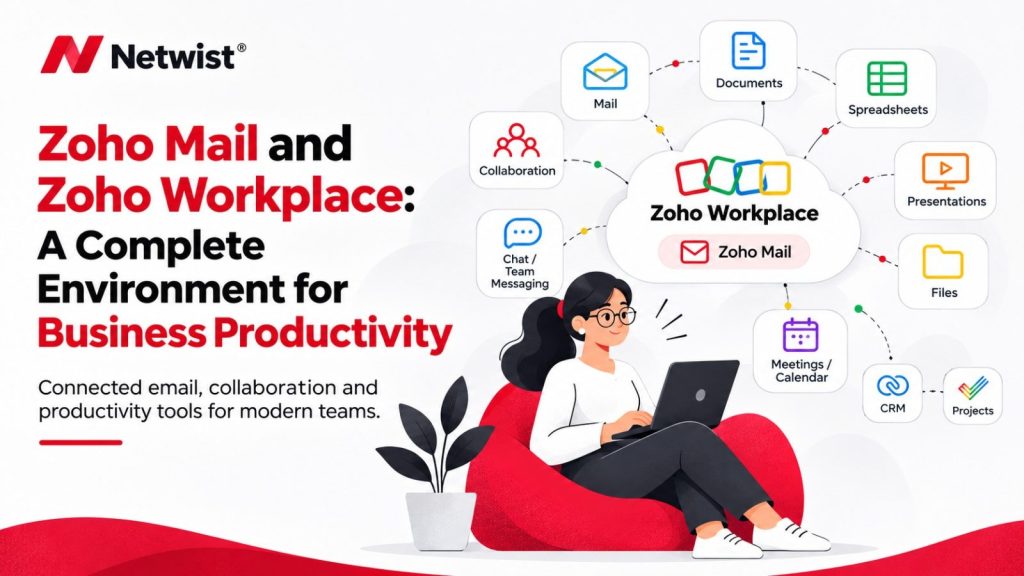
The Zoho ecosystem offers applications for several business functions.
For example, businesses may explore:
- Zoho Mail for business email.
- Zoho CRM for customer management.
- Zoho Desk for customer support.
- Zoho WorkDrive for file management.
- Zoho Projects for project organisation.
- Other applications according to their requirements.
Not every business needs every application. The important thing is selecting tools that support real processes.
Introduce Automation Gradually
Automation can help reduce repetitive tasks and improve consistency.
For example, a website enquiry may be transferred into a customer management system and assigned to the appropriate employee.
Start with a manageable workflow, test it carefully, and measure whether it improves efficiency.
Help Your Team Adapt
Technology alone does not guarantee successful transformation.
Employees need to understand how the new tools work and how they fit into everyday responsibilities.
Provide appropriate training, clear instructions, and a way to report problems.
Involving employees early can also help identify practical improvements.
Measure the Results
Define what success means before implementing a new solution.
You may want to reduce response times, improve customer information management, minimise manual work, or increase online enquiries.
Review these results regularly and adjust your approach as your business develops.
Final Thoughts
Digital transformation does not have to happen all at once. Small, carefully planned improvements can create a stronger digital foundation and help businesses become more efficient.
Netwist supports businesses through web development, business email, Zoho applications, hosting, and technical services.
Ready to take the next step in your digital transformation? Request a consultation with Netwist.