

As Google updates its privacy policy to allow certain Gmail data to contribute to personalized advertising when users enable connected services, businesses are facing an increasingly important question: Who should control their email data, and should private communications ever become part of an advertising ecosystem?
In an era when digital privacy is becoming a fundamental business requirement, the difference between advertising-driven platforms and privacy-focused email providers has never been more relevant.
Zoho Mail offers a compelling alternative, built around a straightforward principle: Your emails belong to you, not to advertisers.
Google’s 2026 Privacy Policy Update: What Has Changed?
On October 16, 2026, Google updated its privacy policy, introducing language that allows information from services such as Gmail, Google Drive, and Google Photos to be used in other Google services that support personalized advertising, when users choose to enable the relevant connections.
This represents an important development in Google’s approach to integrating personal information across its expanding ecosystem of artificial intelligence, search, and productivity services.
Previously, Google had made a clear commitment in 2017 to stop using Gmail message content for advertising personalization. The latest policy update introduces a conditional exception involving user-enabled connections between services.
Google’s updated position does not mean that every Gmail message is automatically scanned to generate targeted advertisements. Instead, users who choose to connect certain services, including AI-powered personalization features, may allow information from those services to influence personalized experiences and potentially advertisements, depending on their settings.
Google’s official 2017 announcement was updated in October 2026 to acknowledge this distinction. blog.google+1
Nevertheless, the development raises legitimate questions about the future of email privacy.
When personal correspondence, search activity, artificial intelligence, and advertising become increasingly interconnected, the boundaries between productivity and commercial data utilization can become less clear.
For businesses handling confidential information, these boundaries matter enormously.
Why Email Privacy Matters More Than Ever
Email remains one of the most important communication channels for modern businesses.
Every day, organizations exchange sensitive information through their email accounts, including financial documents, customer information, contracts, strategic plans, employee records, and confidential negotiations.
An email account is not simply another digital application. It is a central repository of business intelligence and personal information.
Consequently, selecting an email provider should involve more than comparing storage capacity, interface design, or productivity features.
Businesses should consider fundamental questions:
- Is the email service funded by subscriptions or advertising?
- Can account information contribute to advertising personalization?
- Are advertisements displayed within the email interface?
- What security measures protect confidential communications?
- How much control does the organization retain over its data?
These considerations are particularly important for European businesses operating under the General Data Protection Regulation (GDPR), where responsible handling of personal information is a legal and operational priority.
Zoho Mail: A Privacy-First Philosophy
Zoho Mail
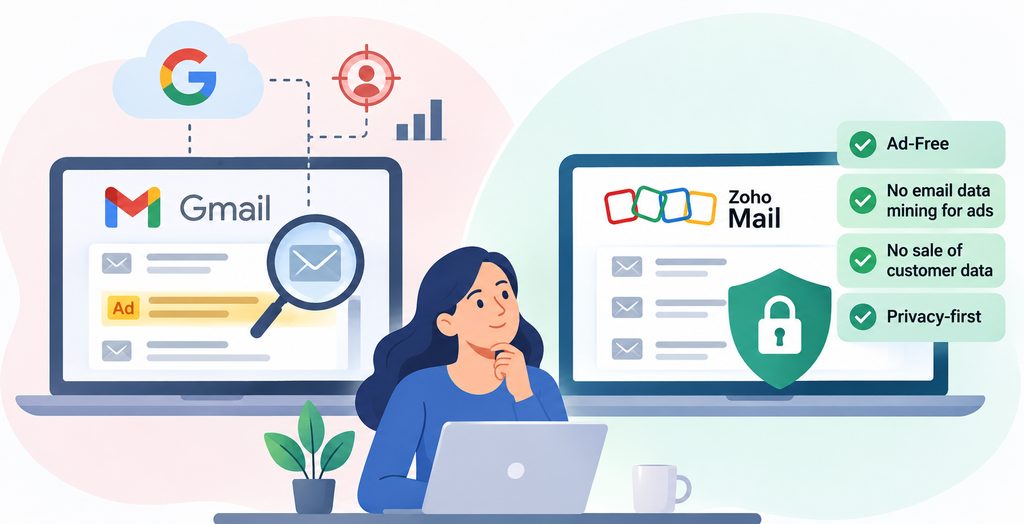
Zoho Mail approaches email hosting with a fundamentally different business philosophy: delivering professional communication services without relying on advertising revenue or monetizing customer information through targeted ads.
Unlike platforms that operate extensive advertising ecosystems, Zoho explicitly rejects the advertising-based business model across its software services.
According to Zoho’s published privacy commitment, the company does not sell customer data and does not display advertisements in its products, including free services.
Its business model focuses on providing software and services directly to customers rather than generating advertising revenue from their activity. Zoho+1
This distinction is particularly meaningful for organizations seeking a long-term email solution aligned with privacy, transparency, and professional independence.
Seven Reasons Zoho Mail Stands Out for Privacy-Conscious Businesses
1. A Completely Ad-Free Email Experience
Zoho Mail does not display advertisements in its email interface. Whether users are managing everyday correspondence or confidential business communications, their inbox remains free from sponsored messages and advertising placements.
This creates a cleaner, more professional, and less distracting environment.
2. No Email Data Mining for Advertising
Zoho states that it does not mine email information to generate targeted advertisements.
While automated processing remains necessary for functions such as spam filtering and malware detection, that processing is not designed to build advertising profiles.
This is an important distinction for companies that want their business correspondence kept separate from commercial advertising activities.
3. Customer Data Is Not Sold to Advertisers
Zoho’s privacy commitment explicitly states that it does not sell customer information.
Its subscription-oriented business model reduces the incentive to turn user activity into an advertising product.
For organizations managing sensitive customer relationships, this represents a valuable commitment to data stewardship.
4. Strong Encryption and Security Controls
Zoho Mail uses AES-256 encryption for stored email data and TLS encryption for supported communications in transit.
It also supports additional security options, including S/MIME and OpenPGP, depending on the plan and configuration.
These technologies help protect sensitive information against unauthorized access.
5. GDPR and Business Compliance Support
Zoho Mail provides features and organizational controls designed to support businesses with privacy and compliance obligations.
Its published security documentation identifies ISO/IEC 27001 and SOC 2 Type II credentials, alongside email archiving and eDiscovery capabilities.
These features can help organizations implement governance and compliance processes, although regulatory compliance ultimately depends on how each organization configures and uses the service.
6. Professional Email Without Advertising Distractions
Zoho Mail supports business email addresses using an organization’s own domain, helping companies maintain a consistent and professional identity.
The absence of advertising complements this professional environment, allowing employees to focus on communication and collaboration rather than sponsored content.
7. A Business Model Built Around Customer Trust
Perhaps Zoho’s most significant advantage is its commitment to generating revenue from software services rather than advertising.
Customers pay for functionality, reliability, and business value, while Zoho publicly commits to keeping their information out of targeted advertising.
This creates a more straightforward relationship between the provider and its customers.
These advantages are supported by Zoho’s published privacy, security, and compliance documentation. Zoho+2
Gmail vs. Zoho Mail: A Privacy and Advertising Comparison
Understanding the practical differences between the two services can help organizations make more informed decisions.
| Feature | Gmail (Personal) | Zoho Mail |
|---|---|---|
| Ads displayed in the inbox | Yes, in certain tabs | No |
| Advertising-based ecosystem | Yes | No |
| Email content used directly for ads by default | No | No |
| Connected-service data potentially used for ad personalization | Yes, with relevant opt-in/settings | No advertising use under Zoho’s stated policy |
| Customer data sold to advertisers | No, according to Google | No, according to Zoho |
| Encryption in transit and at rest | Yes | Yes |
| Business domain email | Through Google Workspace | Available |
| Privacy-focused, ad-free service model | Workspace is ad-free; personal Gmail can display ads | Ad-free across Zoho Mail |
Comparison based on the providers’ published policies as of November 2026. Google’s paid Workspace Gmail is also ad-free; the advertising distinction primarily concerns consumer Gmail and Google’s wider advertising ecosystem. Gmail Help+3
The key difference is not that Google lacks security protections or automatically uses every email for advertising.
Rather, Zoho’s advantage lies in its explicit commitment to keeping advertising entirely outside its email business model.
For organizations that prefer a clear separation between email hosting and advertising, this difference can be decisive.
The Hidden Cost of Advertising-Driven Digital Ecosystems
Many online services appear free at the point of use, but operating large digital platforms requires significant financial resources.
Advertising can help fund these services by using information about user activity to deliver more relevant commercial messages.
This model can offer benefits, including access to sophisticated technology without direct subscription fees.
However, it also introduces questions about how user information moves between services, how personalization evolves, and how much control individuals retain over their digital identities.
Google’s expanding AI ecosystem makes these questions particularly relevant.
As artificial intelligence becomes more capable of interpreting information from emails, documents, and connected applications, users must understand the implications of granting cross-service access.
Even when such connections are optional, organizations need to consider how their employees configure these services and whether those choices align with internal privacy policies.
Zoho’s approach offers an alternative: providing productivity software without incorporating advertising into the relationship between the email provider and its users.
Privacy Is Also a Competitive Advantage
For modern businesses, protecting information is not simply a technical responsibility. It is an essential part of maintaining customer trust.
Clients increasingly expect companies to handle their personal and commercial information responsibly.
This expectation is especially important in industries such as financial services, healthcare, legal services, consulting, accounting, and professional advisory services.
Choosing an email provider with a transparent privacy policy can help demonstrate an organization’s commitment to responsible data management.
Zoho Mail’s advertising-free philosophy can therefore support more than a comfortable inbox experience.
It can become part of a broader organizational strategy focused on privacy, confidentiality, and digital independence.
Of course, choosing an ad-free email provider does not automatically guarantee complete confidentiality. Organizations must still implement strong authentication, access controls, employee training, retention policies, and appropriate encryption.
Zoho Mail provides tools to support these objectives while maintaining its commitment not to use customer information for advertising.
Does Ad-Free Mean More Secure?
Advertising privacy and cybersecurity are closely related, but they are not identical.
An email platform can be ad-free while still requiring robust protection against phishing, account compromise, malware, and unauthorized access.
Likewise, a platform that displays advertisements can implement strong technical security measures.
Zoho Mail combines its advertising-free approach with security capabilities such as encryption, administrative controls, and supported advanced email protection technologies.
Importantly, Zoho Mail is not end-to-end encrypted by default. Organizations requiring end-to-end confidentiality should evaluate its supported OpenPGP capabilities and other available security options.
This distinction matters because meaningful privacy protection requires both responsible data-use policies and appropriate technical safeguards. Zoho Mail+1
Why Businesses Should Consider Moving to Zoho Mail
The discussion surrounding Google’s updated privacy policy provides an opportunity for organizations to reassess their email infrastructure.
Email migration should not be viewed simply as a change of interface or provider.
It is a strategic decision about data governance, communication security, cost predictability, operational independence, and long-term trust.
Zoho Mail offers a strong proposition for businesses that prioritize these considerations.
Its advertising-free experience, commitment against data mining for advertising, professional email hosting, and security capabilities make it an attractive option for companies seeking greater separation between their communications and advertising platforms.
For small and medium-sized enterprises in particular, Zoho Mail can provide a professional communication environment without requiring participation in an advertising-supported email model.
Organizations already using Google Workspace should recognize that Workspace Gmail itself is ad-free. Their evaluation should therefore focus on broader data governance, cross-service integrations, pricing, administrative requirements, and privacy commitments rather than inbox advertisements alone.
The Future of Email Should Put Privacy First
Google’s October 2026 policy update illustrates how the relationship between personal data, artificial intelligence, and digital advertising continues to evolve.
While Google emphasizes user choice and configurable privacy controls, the growing integration of services highlights the importance of understanding where information can travel and how it may be used.
For businesses, this is an opportunity to ask a fundamental question:
Should a professional email provider simply protect and deliver communications, or should those communications potentially become part of a broader advertising and personalization ecosystem?
Zoho Mail provides a clear answer through its business model and privacy commitments.
No advertising in the inbox.
No mining of email content for targeted advertising.
No selling of customer data.
And a professional email environment designed to support businesses without monetizing their communications through advertisements.
Conclusion: Your Inbox Should Be a Private Workspace, Not an Advertising Opportunity
As digital services become increasingly interconnected, businesses must make deliberate choices about the platforms they trust with their information.
Google continues to offer powerful productivity and security technologies, but its advertising ecosystem and evolving cross-service personalization policies deserve careful consideration.
Zoho Mail represents a different approach.
By rejecting advertising as a revenue model and committing to protecting customer information from advertising-related exploitation, Zoho offers organizations a compelling alternative.
For companies that value privacy, transparency, professional communication, and freedom from advertisements, Zoho Mail deserves serious consideration.
Because your business emails should serve your business — not an advertising business.
Choose Privacy. Choose an Ad-Free Inbox.
Discover how Zoho Mail can help your business establish a professional, secure, and advertising-free email environment.
Explore Zoho’s official solutions and privacy commitments.
Explore Zoho MailZoho Privacy Commitment
Sources and further reading
The article draws on Google’s official documentation, Zoho’s published privacy commitments, and reporting on the October 2026 policy update.
- Google Privacy Policy
- Google’s Gmail Advertising Policy — updated October 2026
- Google: How Gmail Ads Work
- Zoho Mail: Data Privacy
- Zoho Mail: Encryption and Security
Contact Netwist today to discuss the right email solution for your business.