

Every business has repetitive tasks that consume time and resources.
Employees may spend hours transferring information between applications, responding to routine enquiries, creating reports, assigning requests, or updating customer records.
Although these activities are often necessary, many can be simplified through business automation.
Business automation uses technology to perform predefined tasks and connect processes, helping organisations reduce manual work and improve operational efficiency.
Identify Tasks That Can Be Automated
The first step is understanding which activities take up unnecessary time.
Look for processes that are:
- Repeated frequently.
- Based on predictable steps.
- Dependent on manual data entry.
- Prone to human error.
- Delayed because information must be transferred between systems.
Examples include sending confirmation emails, assigning enquiries, creating follow-up reminders, and notifying employees about new requests.
Connect Your Business Applications
Many businesses use several applications to manage their operations.
However, when these systems operate independently, employees may need to enter the same information multiple times.
Application integrations can help transfer information between supported systems and reduce duplicated work.
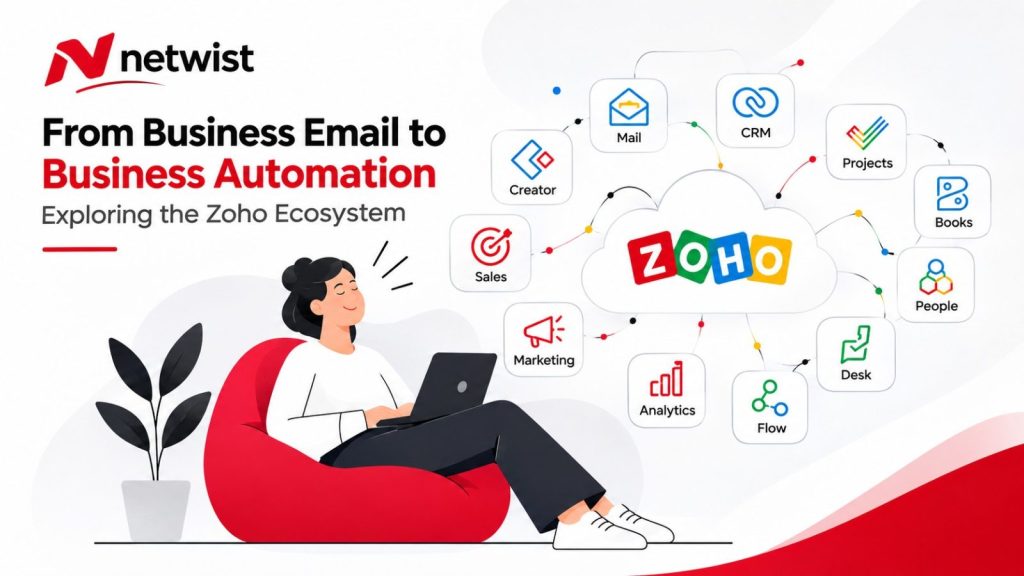
Within the Zoho ecosystem, businesses can explore applications such as Zoho CRM, Zoho Desk, Zoho Forms, and Zoho Flow to support connected workflows.
Automate Customer Enquiries
Consider a business that receives enquiries through its website.
Without automation, someone may need to review every message, copy the details into another system, assign the enquiry, and notify the responsible employee.
With an appropriately configured workflow, a form submission could create a customer record, trigger a notification, and initiate a follow-up process.
The exact workflow depends on the applications and integrations being used.
Improve Internal Organisation
Automation can also help with internal processes.
For example, businesses may automate:
- Task assignments.
- Approval notifications.
- Project updates.
- Customer support routing.
- Recurring reminders.
- Information collection.
This can help employees spend less time on administration and more time on activities that require their expertise.
Start Small and Measure Results
Automation should not be introduced simply because a technology is available.
Start with one process that has a clear business benefit.
Measure how much time it takes before and after automation, whether errors are reduced, and whether employees find the new process easier to use.
Keep human involvement where decisions require judgement or approval.
Maintain Your Automated Workflows
Business processes change over time.
Employees change roles, applications are updated, and operational requirements evolve.
Automated workflows should therefore be documented, monitored, and reviewed regularly to ensure they continue working as intended.
Final Thoughts
Business automation can help organisations reduce repetitive work, improve consistency, and make better use of their existing technology.
Netwist helps businesses explore Zoho applications, integrations, and practical automation opportunities that support their everyday operations.
Ready to make your business work smarter? Contact Netwist to discuss your automation requirements.